
Companies / 9 November 2026
Palantir Technologies
The systems institutions come to depend on
Palantir turns fragmented data into operational decisions. Follow the contracts, financial results and public records to see what its software does, where institutions depend on it and what remains unknown.
Research by Stillwater Meridian
Download the full report (PDF) Meet the people in this investigationExecutive summary
Palantir sells software that helps institutions turn fragmented records into decisions and actions. An airline can track aircraft and maintenance work. A military command can combine sensor reports and nominate targets. The stakes differ, but both workflows rely on knowing which records refer to the same thing, who can see them and what users are allowed to do. Palantir calls the layer that encodes those rules the Ontology. [1] [2] [3] [4]
The business grew from $2.866bn in FY2024 revenue to $4.475bn in FY2025, while its GAAP operating margin rose from 11% to 32%. Q3 2026 produced $2.313bn of revenue, up 96% year on year, and $1.085bn of operating income, a 47% GAAP operating margin. US commercial revenue reached $984m, surpassing US government revenue of $953m for the first time, according to Palantir. [1] [5] [6]
Commercial revenue also passed government revenue globally in Q3, $1.168bn versus $1.146bn. Government still led over the first nine months, with $2.994bn versus $2.887bn. [7] [1] [6]
Palantir's Q3 investor update put net-dollar retention at 165%. The prior customer cohort generated 65% more trailing-twelve-month revenue than it had a year earlier, after accounting for churn. Palantir reported 1,090 customers. [8] [6]
Government contract figures need their own accounting. The Army's $10bn enterprise agreement is a purchasing ceiling. An older indexed USAspending record for one separate Maven vehicle lists $292.68m in child-award obligations and $1.72m in reported child-award outlays. Those figures cover that vehicle's reported child awards. They cannot establish programme-wide payments. [5] [9] [6] [10]
The clearest evidence of switching costs comes from the UK Ministry of Defence. In justifying a £240.6m direct award, the MOD said replacing the embedded system would require rebuilding its analytics architecture, obtaining security accreditation and retraining staff, with disruption to military planning and allied interoperability. NHS England negotiated exit provisions for its own platform, where the practicality of moving live workflows remains an open question. [11] [12] [13] [14] [15]
The stakes change with the deployment. The US Army designed TITAN to accelerate target nomination. ICE's procurement describes immigration enforcement prioritisation and removal logistics. The NHS says it controls the data used on its platform, while the government confirmed three Palantir engineers had administrative access to the national integration environment. The public records establish intended functions and some access arrangements. They provide far less visibility into performance, errors or individual decisions. [16] [17] [18] [19]
Palantir reports through two customer segments, government and commercial. It sells subscriptions, licences and professional services. The mix of data modelling, deployment and training varies by engagement. [1] [6]
Palantir's strategic advantage is that customers can change an AI model while continuing to run the surrounding data, permissions and workflows on its platform. The harder question is whether they can replace that platform and keep the institution functioning throughout the transition. [4] [20]
Corporate evolution, ownership and control
Palantir was incorporated in Delaware in 2003 and initially focused on US intelligence and counterterrorism. Historical accounts identify Alexander Karp, Peter Thiel, Stephen Cohen, Joe Lonsdale and Nathan Gettings as the early founding team. Palantir's voting agreements use a narrower definition of founders, covering Karp, Cohen and Thiel. The company went public through a direct listing on the New York Stock Exchange in 2020 and transferred to Nasdaq in 2024, where it trades as PLTR. [1] [21] [6] [22] [23] [24]
Gotham grew out of the intelligence business. Foundry, launched in 2016, expanded the approach to commercial organisations. Apollo gave Palantir a way to manage software releases across cloud, private, classified and disconnected environments. In 2023, AIP added tooling to connect AI models to governed data and workflows. [2] [25] [22] [26]
The 2026 election returned Peter Thiel, Alexander Karp, Stephen Cohen, Alexander Moore, Alexandra Schiff, Lauren Friedman Stat and Eric Woersching to the board. Karp serves as chief executive, Cohen as president and secretary, and Thiel as chair. [27] [28] [29]
The voting structure deserves more attention than its small number of Class F shares might suggest.
| Security / group | Economic form | Voting treatment | Control significance |
|---|---|---|---|
| Class A common | Public/common equity | 1 vote per share | Main publicly traded class |
| Class B common | Super-voting common | 10 votes per share | Concentrates voting rights among holders, including founders |
| Class F common | 1.005m shares in the founder voting trust | Variable voting power | Generally brings the defined founder bloc to as much as 49.999999% of the vote, subject to charter terms and exceptions |
| Founder group | Karp, Cohen, Thiel | Applicable Class A and B votes plus Class F | Voting influence can differ substantially from economic ownership |
| Minimum ownership test | Founder group and specified affiliates | 100m equity securities as at 30 Sep 2026 | Required for continuation of Class F control mechanism |
Source: Palantir's 2026 proxy and Q3 2026 Form 10-Q. [6] [27]
For the 2026 director-election proposal, the formula assigned roughly 1,259.505 votes per Class F share, or 27.7% of total voting power entitled to vote. That percentage covers Class F alone. The defined founder bloc also included applicable Class A and B votes. The September 2026 filing describes circumstances in which the founders and affiliates could exceed the formula's general 49.999999% target through their other holdings or votes. [29] [6]
The structure gives public shareholders less influence over leadership and strategy than a one-share-one-vote structure would. Palantir warns in its filing that the founders' voting influence can diverge from their economic interests. [30] [6]
Palantir has used partnerships, strategic investments and acquisitions alongside internal development. The 2016 Silk transaction brought in a data-visualisation team. Palantir says it protects its software with patents, copyright, trademarks and trade secrets and does not depend on any single patent. [1] [31]
Two 2026 US patent grants cover indexing across Ontology-based databases and data-security governance in shared infrastructure. Separate published patent applications address lineage and permissions. The patents show where Palantir has sought intellectual-property protection. The switching costs documented by the MOD arise from the software and work already embedded in its operations. [32] [33] [34] [35] [36]
How the platform works
Palantir documents Foundry, AIP and Apollo as its standard integrated architecture. Gotham supports government and defence work and uses related concepts. The following examples show how the pieces can fit together. Individual deployments vary. [2] [3]
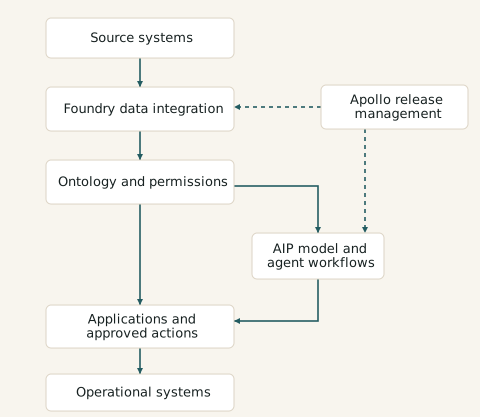
- Foundry integrates data from source systems. The Ontology defines the objects and permissions used by applications.
- AIP connects models and agents to governed data and approved actions. Those actions can interact with operational systems.
- Apollo manages releases across deployment environments.
This synthesis follows Palantir's published architecture documentation: Foundry provides core data operations; AIP adds secure model connectivity and AI workflows; Apollo deploys and updates the software across heterogeneous environments; the Ontology represents enterprise objects, relationships, actions and security. [2] [25] [37] [3]
Gotham brings together intelligence, operational and geospatial data. Its published materials show how analysts and operators can combine historical and live sensor data, view relationships and plan missions. Where software sits in a particular military targeting workflow depends on the system and deployment. [2] [17] [38]
Foundry is the enterprise data and application platform. It ingests data from source systems, transforms it, applies governance and lineage, maps data into business objects and lets customers build applications against those objects. Its value proposition differs from a traditional data warehouse because the target state is not simply “all data in one place”; it is a model of how the organisation operates. [2] [3]
AIP, the Artificial Intelligence Platform, connects models and automated workflows to governed data and Ontology objects. Palantir documents support for GPT, Gemini, Claude, Grok and Llama families, with availability varying by enrolment and geography. Customers can configure what a model may retrieve and which actions it can invoke. [37] [20]
Apollo manages deployments and releases across public cloud, customer infrastructure and disconnected or air-gapped systems. Classified or tactical deployment also depends on the customer's configuration and accreditation. [25] [39]
Ontology is arguably Palantir's most important technology. It creates typed objects—an aircraft, patient, shipment, bank account, production line, intelligence report or military unit—with properties and relationships, then attaches governed actions and functions to them. Permissions can be propagated down to fine-grained data elements and actions. A user therefore does not merely see “row 1834 in table X”; they see an aircraft, its maintenance state, related parts, assigned work orders and the actions they are authorised to take. [3] [40] [41] [4]
That creates several distinct lock-in vectors.
| Lock-in vector | Why replacement is hard | Countervailing portability mechanism |
|---|---|---|
| Ontology semantics | Years of object definitions, relationships and business logic accumulate | Data can remain in source systems; APIs/SDKs expose portions of the model |
| Permissions | Fine-grained access rules become embedded in workflows | Customers can retain external IAM/governance systems |
| Applications | Internal tools are built against Palantir objects and APIs | Ontology SDKs and external APIs can facilitate integration |
| Actions/write-back | Palantir becomes part of transactional workflows, not just analytics | Actions can invoke external systems rather than replacing them |
| AI grounding | Retrieval rules, prompts and action permissions may refer to Ontology objects | Customers can substitute supported models where configuration, enrolment and accreditation allow |
| Operational accreditation | Classified systems require security accreditation and testing | Public-sector contracts can mandate exit/transition planning |
| Institutional knowledge | Operators become trained on Palantir applications and workflows | Training and documentation can reduce but not eliminate transition cost |
| Deployment | Apollo manages releases across different environments | Standard infrastructure can ease some migration work, while release processes and accreditation still need to be addressed |
The UK MOD's direct-award justification says Palantir alone could license and fully support the existing architecture for the requirement. In the MOD's assessment, a change would mean rebuilding analytics, securing accreditation at the required classifications and retraining users while maintaining operations and interoperability with allies. [11] [13]
That is what operational dependence can look like. A replacement would need to reproduce the data flows, permissions and actions that staff use every day while the organisation keeps working. [4]
NHS England says its contract requires exit planning, interoperability standards and services designed for migration. It owns the commissioned Canonical Data Model, while Palantir retains its Foundry intellectual property. The Commons Library says public information gives an incomplete picture of how deeply the platform is embedded and what switching would mean for healthcare delivery. [42] [14] [15]
AWS, Microsoft Azure, Google Cloud and SAP partnerships let Palantir work with existing enterprise systems and infrastructure. This positions Palantir to sell the layer that connects those systems to an institution's rules and workflows. [43] [44] [45] [46] [47]
Financial performance
| Metric | FY2024 | FY2025 | 9M 2026 | Q3 2026 |
|---|---|---|---|---|
| Revenue | $2.866bn | $4.475bn | $5.881bn | $2.313bn |
| Growth | 29% | 56% | 92% YoY | 96% YoY |
| Government revenue | $1.570bn | $2.402bn | $2.994bn | $1.146bn |
| Commercial revenue | $1.296bn | $2.073bn | $2.887bn | $1.168bn |
| Gross margin | 80% | 82% | 85% | 83% |
| GAAP operating income | $310m | $1.414bn | $2.751bn | $1.085bn |
| GAAP operating margin | 11% | 32% | 47% | 47% |
| Consolidated net income | $468m | $1.635bn | $3.077bn | $1.134bn |
| Operating cash flow | $1.154bn | approx. $2.13bn | $3.320bn | $1.205bn |
| Stock-based compensation | $692m | $684.033m | $785.690m | $318.889m |
| Cash, cash equivalents and marketable securities at period end | $5.230bn | $7.177bn | $10.562bn | $10.562bn |
The Q3 and nine-month columns share a 30 September 2026 balance-sheet date. Palantir separately reported $10.4bn in cash, equivalents and US Treasury securities. Q3 net income attributable to common shareholders was $1.128bn. [7] [1] [6] [5]
Q3's 62% adjusted operating margin excludes $318.889m of stock-based compensation and $23.106m in related employer payroll taxes. The 47% GAAP operating margin includes both. Stock-based compensation was 13.8% of Q3 revenue and 13.4% for the first nine months. [5] [6]
Revenue mix has shifted dramatically.
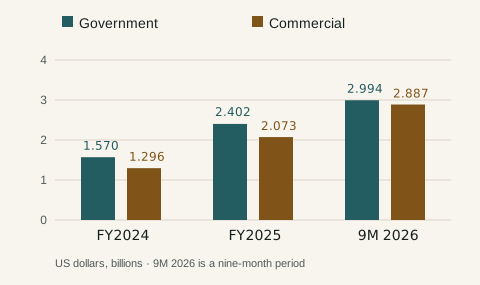
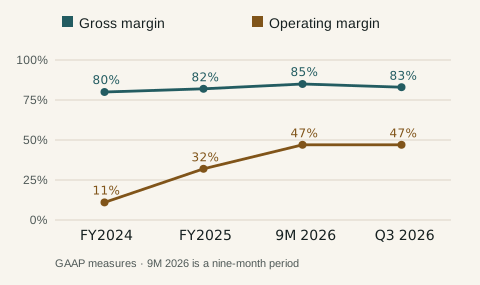
The US accounted for 66% of revenue in FY2024, 74% in FY2025, 81% in the first nine months of 2026 and 84% in Q3 2026. US customers accounted for most of the year-on-year dollar growth in Q3. [7] [1] [5]
Sales and marketing fell from 31.0% of revenue in FY2024 to 23.6% in FY2025 and 17.1% in Q3 2026, calculated from reported dollars. In Q3, R&D represented 9.5% and general and administrative expenses 9.9%. [1] [6]
There are several reasons. Existing customers contribute heavily to growth. In the first nine months of 2026, Palantir says $1.3bn of the increase in government revenue came from government customers existing at the end of 2025, while $1.2bn of commercial growth came from existing commercial customers. Q3 net-dollar retention of 165% corroborates extreme expansion within the installed base. [6] [8]
These figures support the view that Palantir can win an initial deployment and expand it. They leave open how much of the margin gain came from that expansion, the product mix or other factors.
At Q3 2026 Palantir reported 212 deals of at least $1m, including 107 of at least $5m and 64 of at least $10m. Total TCV closed was $2.918bn, up only 6% year on year, and US commercial TCV was $1.463bn, up 11%. The contrast with 96% company revenue growth and 148% US commercial revenue growth is important. [5]
The divergence is worth tracking. Revenue reflects work recognised in the quarter, including under earlier deals. TCV reflects the estimated lifetime value of deals closed in the quarter, which can move with contract duration and option terms.
Palantir's “remaining deal value” has a similar caveat. The company describes RDV as remaining value of contracts but notes that government options may never be exercised, contracts can contain termination-for-convenience provisions and historical contract values are not guaranteed to turn into revenue. At the end of 2025 Palantir had $11.2bn of remaining deal value, including about $6.8bn commercial and $4.4bn government. US commercial RDV alone had risen to $6.517bn by Q3 2026. [6] [5]
The common architecture supports repeat deployments, and the filings also identify professional services, training and customer-specific configuration. Palantir sometimes funds pilots and bootcamps itself, and conversion into contracts is uncertain. Q3 cash from operations less capital expenditure was $1.197bn. Palantir's adjusted free cash flow of $1.216bn adds back certain employer payroll taxes. [6] [5]
The top 20 customers averaged $146m in trailing-twelve-month revenue. Multiplying the rounded average by 20 gives about $2.92bn, or 40.1% of total trailing revenue of $7.288bn. Palantir counts some separately contracted and invoiced divisions of the same government agency as individual customers. [6] [1]
Government contracts and deployments
A ceiling sets the maximum available under a contract vehicle. An obligation records a legal commitment of funds. A reported outlay records disbursement. Orders, deliveries, acceptance and recognised vendor revenue each require their own evidence.
| Programme | Award or ceiling | Obligations and outlays | Scope | Named suppliers | Open evidence |
|---|---|---|---|---|---|
| US Army Enterprise Agreement | Up to $10bn over up to ten years | $10bn purchasing cap | Consolidates 75 contracts | Palantir | Order-by-order obligations and outlays remain open [9] [48] |
| Maven Smart System W911QX24D0012 | $480m ceiling in May 2024, increased by $795m to $1.275bn in May 2025 | Older indexed USAspending snapshot shows $292.681m in obligations and $1.719m in outlays for two child awards | Maven software, including a UI/UX prototype delivery order | Palantir USG | Snapshot coverage and payments need reconciliation [10] [49] |
| Separate Maven W911QX24D0026 | $99.805m Sep 2024 | Public obligation reconciliation incomplete in reviewed sources | Licences/support/hardware | Palantir | Need FPDS/USAspending child-order reconciliation [50] |
| TITAN Phase III prototype | $178.4m, Mar 2024 | Award amount published | Ten prototype systems originally specified | Palantir-led team | 2026 Army says nine prototypes retained; fate/status of tenth not explained [16] |
| TITAN initial production | $192m in two orders as of 31 August 2026, announced 1 September | $127m Palantir and $65m Anduril | Eight systems, four Advanced and four Basic, scheduled over 18 months | Palantir leads production, Anduril supplies hardware and shelter integration | Acceptance and payment milestones open [17] |
| USSOCOM | $463m five-year IDIQ ceiling, H92433-23-D-0001 | $29.505m obligated at award | Development and sustainment | Palantir | Later orders and payments need reconciliation [51] |
| UK MOD enterprise agreement | £240.6m, signed 30 Dec 2025 | Contract value known; payment schedule not publicly reconciled here | 1 Apr 2026–31 Mar 2029, classified analytics and operational decision support | Palantir UK | Redacted contract obtainable; need invoice/payment-level reconciliation [12] |
| NHS FDP | Up to £330m over seven years for the consortium | £25.6m first-year spending expectation | Up to 240 NHS organisations | Accenture, PwC, NECS and Carnall Farrar | Actual consortium and supplier receipts open [52] |
| ICE ImmigrationOS / ICM | Two 2025 modifications to order 70CTD022FR0000170 | FPDS lists $29,898,236 action obligation for P00009 in April and the same amount for P00012 in September | Prototype, then continued licences and support | Palantir | Net obligations, payments and acceptance need reconciliation [18] [53] |
| ICE 2026 ERO modernisation | Order 70CTD026FC0000012 | $86,271,599.30 obligated and outlayed in the reviewed USAspending record | Enforcement case management and analytics modernisation | Palantir | Module-level link to ImmigrationOS open [54] |
| NATO Maven | Core acquisition price unverified | Payments unverified | Acquired March 2025, technical readiness June 2026 | Palantir, NCIA and SHAPE | Licence structure and routine use remain open [55] |
| Ukraine | Aggregate award value unverified | Payments unverified | Defence, law enforcement, reconstruction and demining | Ukrainian ministries and agencies | Commercial terms and military deployment details remain open [56] |
| Israeli Ministry of Defense | Strategic partnership disclosed in 2024 | Pricing and payments unverified | Technology to assist Israel during the war, per Palantir | Palantir | Specific systems and mission outcomes unverified [57] |
The figures in this table describe different stages of procurement. Amounts are in the original currencies.
The US Army's enterprise agreement consolidated 15 prime contracts and 60 related agreements. The Army said it gives agencies a common purchasing vehicle and volume-based discounts. In an earlier procurement, the Federal Circuit upheld an injunction against the Army's DCGS-A2 solicitation after the Army failed to determine whether commercially available products could meet its requirements or be modified to do so. The two episodes show how procurement rules can open a route to a commercial supplier and how an established relationship can later be consolidated. [9] [48]
The indexed USAspending view for US Maven vehicle W911QX24D0012, retrieved on 9 November 2026 from an older snapshot, listed $292,680,689.24 in combined child-award obligations and $1,718,750.01 in combined reported child-award outlays. The visible obligations were associated with W911QX24F0053, whose description identifies a user-interface prototype. This snapshot does not capture all Maven awards or establish the payment history. The separate W911QX24D0026 vehicle and later enterprise orders need their own reconciliation. [10] [58] [49] [50]
TITAN demonstrates Palantir moving beyond pure software into a prime production role. The Army describes the system as an expeditionary intelligence ground station capable of ingesting data from multiple sensors, applying AI and accelerating target recognition, geolocation and automated target nomination. The 2026 production arrangement is especially revealing: Palantir leads system production, whereas Anduril is paid separately for hardware components and shelter integration. [17]
| Year | Milestones |
|---|---|
| 2022 | UK MOD enterprise agreement £75.216m. Palantir expands work in Ukraine. |
| 2023 | NHS England awards FDP to Palantir-led consortium. USSOCOM five-year IDIQ up to $463m. |
| 2024 | TITAN Phase III prototype award $178.4m. Maven US contract $480m. Israel Ministry of Defense strategic partnership disclosed. |
| 2025 | Maven ceiling increased to $1.275bn. NATO acquires Maven Smart System. US Army Enterprise Agreement up to $10bn. ICE ImmigrationOS procurement. UK announces wider defence strategic partnership. UK MOD signs £240.6m follow-on agreement. |
| 2026 | NATO Maven reaches full technical operational capability. TITAN production orders $127m Palantir + $65m Anduril. ICE ERO modernisation order $86.27m. |
Selected milestones from agency notices and parliamentary records. [59] [60] [61]
The UK was Palantir's largest individually disclosed non-US customer geography in FY2025. Revenue from all UK customers was $427.398m, or 9.55% of group revenue. The filing does not split that figure by customer type. The separate £240.6m MOD agreement runs from April 2026 to March 2029. [1] [12]
The procurement method is politically relevant. It was a direct award, justified on technical grounds under the Procurement Act. The MoD's rationale is unusually explicit about dependency on Palantir architecture. That makes the contract simultaneously evidence of Palantir's technological moat and evidence of the competitive-policy risk created when a sovereign customer becomes difficult to migrate. [11] [13]
The NHS Federated Data Platform is different: NHS England says it was competitively tendered. The Palantir-led consortium includes Accenture, PwC, NECS and Carnall Farrar. The £330m is the maximum platform-contract value over seven years, not Palantir revenue; a larger £480m FDP programme figure sometimes cited includes a separate £150m multi-vendor solution exchange. [52] [62]
The NHS contract began in March 2024. The initial three-year term ends in March 2027. The Commons Library said an extension decision was due by December 2026. Two parliamentary committees recommended letting the initial term end and pursuing an alternative. The materials reviewed through 9 November 2026 did not establish that an extension decision had been announced. [14] [63] [64] [42] [15]
ICE's April 2025 justification describes enforcement prioritisation, tracking departures and removal logistics. FPDS records the two 2025 obligations on the earlier ICM order. The $86.27m May 2026 ERO order and a separate $32.106m September 2026 DHS software licence share purchasing agreement 70RTAC26A00000001. The available descriptions do not identify which ImmigrationOS functions those 2026 orders funded. [65] [18] [53] [54] [66]
NATO finalised the Maven acquisition on 25 March 2025. Its Joint Warfare Centre says the system reached full technical operational capability on 22 June 2026 following accreditation and exercise testing. NATO also documented an exercise that exchanged information with the US Maven system. The main acquisition price and the scope of routine use across commands remain unverified. [67] [55] [68]
Ukraine shows how Palantir can enter a country through several ministries and use cases without a transparent single contract. Ukraine's Ministry of Digital Transformation said in 2023 that Palantir already supplied software to law enforcement and supported defence and reconstruction. A 2024 Ministry of Economy agreement applies AIP to humanitarian demining, integrating data about contaminated land, resources, surveys and economic priorities to recommend clearance strategies. Public sources establish extensive use; they do not disclose a comprehensive contract value. [56] [69]
For Israel, Palantir's SEC filing is the most reliable baseline: it states that in 2024 Palantir agreed a strategic partnership with the Israeli Defense Ministry to supply technology assisting Israel in the ongoing war, but says Ukraine- and Israel-related operations were not material to financial results at that time. Palantir has separately denied involvement with specific Israeli targeting systems such as “Gospel” and “Lavender”. Public evidence is insufficient to infer that Palantir software selects individual targets merely from the existence of the MoD partnership. [57] [70]
Political influence, legal exposure and human rights
Palantir's own US Lobbying Disclosure Act filings report $1.98m in Q1 2026, $2.08m in Q2 and $2.11m in Q3, totalling $6.17m through September. Disclosures identify defence and government issues among the areas lobbied. Outside lobbying firms also report work for Palantir, but those amounts should not simply be added to Palantir's own expense figure because LDA accounting can already include external-firm costs. [71] [72] [73]
The FEC summary for the Employees of Palantir Technologies Inc. PAC covers 1 January 2025 to 14 October 2026. It shows $97,240.41 in receipts, $116,424.32 in disbursements, including $105,000 contributed to other committees, and zero independent expenditures. The PAC, Palantir's lobbying expense and individual political donations are three separate ledgers. [74]
The UK revolving-door picture warrants scrutiny but careful wording. Former Armed Forces minister Leo Docherty became a Palantir adviser after leaving government; ACOBA found no evidence he made decisions specific to Palantir while in office and imposed restrictions on his activities. Former AUKUS Director General Damian Parmenter likewise joined Palantir under restrictions. Laurence Lee, formerly an FCDO director general and previously Second Permanent Secretary at the MoD, became a Palantir adviser after having had meetings with the company while in government; ACOBA restricted him from working on UK defence and national-security matters on Palantir's behalf. [75] [76] [77]
The appointment records document access and post-employment restrictions. The MOD told the advisory committee that Laurence Lee met Palantir nine times between 2021 and 2023, had management oversight of the earlier agreement and pressed for progress on its timetable. The department said he made no Palantir-specific decision. The government separately said no ministers or former officials with prior Palantir links took part in approving the December 2025 award. [76] [75] [19]
Palantir identifies privacy, public procurement, AI, export controls, sanctions and anti-bribery rules among its regulatory exposures. Its filing says some products are subject to US export administration rules and describes defence export classification as a potential issue. [1]
In Cupat, plaintiffs alleged misleading statements about Palantir's business and prospects. The district court dismissed the case with prejudice on 4 April 2025. Plaintiffs appealed on 2 May 2025 and the Tenth Circuit heard argument on 16 March 2026. In its September 2026 filing, Palantir said it was unaware of pending matters it expected to materially harm its financial statements. [78] [6]
In March 2026, the Information Commissioner's Office upheld a policy-formulation exemption for requested FDP information. The decision was listed as under appeal. In April, the ICO ordered NHS England to disclose withheld invoice pricing while allowing it to withhold template details. The order establishes the disclosure requirement. It does not establish that a complete invoice series was released. [79] [80]
Human-rights analysis should distinguish four separate questions: what the software is technically capable of doing; what the contract authorises; what operators actually do with it; and whether that use causes unlawful harm. Public debate often collapses those into one.
ICE's procurement sets out the functions it wanted. Amnesty International argues that Palantir's immigration work poses privacy and due-process risks. Palantir said it did not create or operate the State Department's Catch and Revoke platform or apply AI surveillance tools to student protesters. Amnesty clarified that it was raising concerns about indirect implications of ICE's use. [65] [81] [18] [82]
For military deployments, the ethical stakes are higher because Palantir can be positioned in the sensor-to-decision-to-action chain. TITAN is explicitly designed to speed target recognition, geolocation and target nomination; NATO says Maven supports targeting and intelligence fusion. Faster decision cycles may improve accuracy and situational awareness, but they can also compress human review, propagate upstream data errors and make responsibility harder to attribute when recommendations emerge from complex fused systems. The public documentation establishes the operational purpose; it does not provide sufficient data to calculate false-positive rates, civilian-harm effects or human override rates. [17] [67]
Palantir documents permissions, audit logs and configurable action controls. For a given deployment, oversight depends on how customers configure those controls, which actions require review and whether an operator can inspect and challenge a recommendation in time. [41] [83]
In healthcare, the dispute centres on patient confidence, access to identifiable data and whether public services can switch suppliers. NHS England controls the data at the national level and directs suppliers as processors. The government confirmed on 22 October 2026 that three Palantir engineers had administrative access to the National Data Integration Tenant. As of 15 June 2026, a further 12 Palantir engineers were among 33 people with limited project-specific access. The National Data Guardian records that NHS England's earlier communications had failed to explain why some suppliers needed limited access to identifiable data. [42] [63] [19] [84]
Competition and the Anduril partnership
Competition varies by layer. Databricks and Snowflake overlap in data platforms. Hyperscalers provide infrastructure and AI services and also build competing tools. Systems integrators and defence primes compete for some implementation work. AIP's support for multiple model families lets Palantir sell the layer between the models and the workflow. [37] [45] [46] [43]
Palantir combines data integration, permissions, applications, AI tooling and software deployment. Apollo helps it manage releases across cloud, on-premises and disconnected environments. Comparative advantages depend on the workflow, accreditation requirements, alternatives and migration costs. [2] [25]
Its weaknesses follow from the same architecture. Palantir implementations can become deeply intertwined with customer operations, generating procurement concern about dependency. The sales model still relies on significant technical engagement. Political objections to defence, policing or immigration work can spill into unrelated markets. Founder control limits outside shareholder influence. The company's rapid growth is increasingly concentrated in the United States. And although GAAP margins are already extraordinary, stock compensation remains meaningful. [11] [1] [6]
The comparison with Anduril is therefore more useful when viewed as a stack than as a binary rivalry.
| Dimension | Palantir | Anduril |
|---|---|---|
| Core identity | Data/AI operating platform | Software-defined defence systems company |
| Primary abstraction | Ontology, data and decision workflow | Lattice, autonomy and physical mission systems |
| Hardware | Increasing integration role but generally partner-based | Core: aircraft, underwater systems, sensors, effectors and tactical hardware |
| Deployment | Enterprise/cloud/on-prem/classified/edge | Tactical edge and autonomous systems |
| Revenue model | Predominantly software, subscriptions/licences/services | Mix of hardware, software and production programmes |
| Margin potential | Very high software gross margins | Structurally more manufacturing-intensive |
| Procurement strength | Embedded enterprise/government software, data integration | Rapid COTS hardware development and autonomous systems |
| Core moat | Operational data model + installed workflows + security/deployment | Vertical hardware/software integration + autonomous mission capability |
| Principal dependency | Customer data/workflow integration | Manufacturing, supply chain, programme execution |
| Joint integration | Can integrate approved Anduril feeds and workflows where configured | Can supply tactical sensing, communications and hardware |
Anduril builds autonomous systems, sensors and other defence hardware alongside its Lattice software. Palantir generally supplies software and works with partners when a programme requires hardware. TITAN shows where those roles meet. [85] [86]
A December 2024 joint announcement describes connecting Anduril's Lattice and Menace edge systems to Palantir AIP. The TITAN production orders document the companies' specific responsibilities. The US Army also reports that Anduril and Palantir are partnered on an edge-to-cloud data mesh for Next Generation Command and Control, using Lattice and Foundry. [87] [17] [88]
This leads to an important strategic interpretation: Palantir and Anduril may compete for control of the defence software layer while simultaneously making each other more valuable. Anduril generates sensor data and operates autonomous systems at the physical edge; Palantir can integrate those feeds with intelligence, logistics, command and planning data across the wider organisation. The contest is ultimately over which platform becomes the system of record and orchestration layer for military decision-making.
Cloud partnerships give Palantir several deployment channels. Its own infrastructure obligations are substantial. The Q3 2026 filing discloses a minimum $5.6bn cloud-hosting commitment to one unnamed provider through February 2036. Model competition could strengthen the value of the software that provides context, permissions and action interfaces, although that remains a strategic scenario. [43] [37] [45] [46] [89]
Open standards and cloud-native tooling could make operational models easier to rebuild. The MOD case illustrates the practical hurdles for an embedded installation. [11] [13]
Open questions
- Army $10bn agreement: obtain a complete task-order ledger showing obligations, cancellations, options and payments under the consolidated vehicle. The $10bn figure should never be treated as booked revenue. [9]
- Maven. Reconcile transactions, obligations and outlays for both known vehicles and later orders. Retain the first vehicle's indexed snapshot as a dated observation. [10]
- TITAN: determine why the 2024 public record described ten prototypes while the 2026 Army release says nine are retained, and obtain production milestone/payment data for the eight initial-production systems. [17]
- UK MOD: obtain the redacted £240.6m enterprise agreement and quarterly KPI reports, then reconcile invoice-level payments against the contract. The procurement notice says a redacted version can be requested. [12]
- NHS: separate consortium receipts into Palantir, Accenture, PwC, NECS and Carnall Farrar economics; monitor the extension decision due in late 2026; test how practicable the contractual exit provisions are in a real migration. [42] [14]
- ICE. Reconcile the 2025 modifications, the two 2026 orders and their separate award scopes. Establish which data and recommendation functions operators use. [65] [54] [53] [66]
- NATO: establish the undisclosed value and licence structure of the principal Maven Smart System acquisition. The €160,000 engineering-support RFQ published in October 2026 is a small support procurement, not evidence of the main platform price. [90] [67]
- Ukraine and Israel: public disclosures establish operational relationships but not comprehensive pricing, detailed scope or system-by-system use. Claims about specific strike or targeting decisions should therefore be treated as unverified unless supported by mission-level evidence. [69] [56] [57]
- Bookings quality: track TCV alongside revenue, contract duration, RDV and remaining performance obligations. Q3's 96% revenue growth versus 6% TCV growth is a divergence worth monitoring rather than assuming either bullish or bearish significance. [5]
- Customer concentration: Palantir discloses extraordinary expansion among its largest customers but not a full top-20 customer identity/revenue table. The inferred roughly 40% TTM contribution from the top 20 deserves monitoring as absolute contract sizes rise. [6]
- Human oversight: military and immigration procurement documents describe the intended capabilities, but there is very little public quantitative evidence on false-positive rates, recommendation rejection rates, human override frequency, downstream error correction or civilian-harm attribution. Those are the critical metrics for judging operational and human-rights consequences. [17] [65]
What it takes to switch
AIP extends Palantir's existing approach to AI models. The model can be one interchangeable component in a workflow that still depends on customer data, permissions and approved actions. [2] [37] [3] [4] [20]
The highest stakes are where those workflows affect hospital capacity, immigration enforcement or military targeting. A buyer considering a switch has to account for the time needed to recreate the workflow, the authority to act and the consequences of disruption. [42] [17] [65] [67]
The MOD renewal shows how strongly those costs can shape a procurement decision. The NHS contract offers a test of whether negotiated exit provisions are enough to make a live public service portable. The record is clear about the dependency the MOD identified. The NHS case will turn on whether another supplier can reproduce the workflows and safeguards while the service keeps running. [5] [9] [55] [13] [14]
Sources
Evidence reviewed through 9 November 2026. Filings establish reported financial results and governance disclosures. Procurement records establish the amounts and scope recorded in those systems. Product documents describe design and available features. Deployment, performance and causation require separate evidence.
- pltr-20251231
- Palantir platform architecture
- www.palantir.com
- Palantir Ontology documentation
- www.sec.gov
- www.sec.gov
- www.sec.gov
- Palantir Q3 2026 investor presentation
- US Army enterprise agreement
- USAspending Maven IDV and child awards
- Page 1 to 5
- www.find-tender.service.gov.uk
- MOD procurement justification
- Commons Library on FDP
- NHS England contract explainer
- Army Tactical Intelligence Targeting Access Node (TITAN) Ground Station Prototype - Award - Capability Program Executive - Intelligence and Spectrum Warfare - CPE ISW
- US Army TITAN production notice
- ICE limited-sources justification
- UK government response to Parliament
- AIP supported models
- www.sec.gov
- Palantir 2020 listing prospectus
- Palantir Nasdaq transfer announcement
- Forbes historical account of Palantir's founding
- www.palantir.com
- Palantir AIP introduction
- pltr-20260423
- www.sec.gov
- 2026 election and voting results
- pltr-20260630
- TechCrunch on the Silk transaction
- Efficient data indexing across multiple ontology-based databases
- patents.google.com
- patents.google.com
- Fine-grained permissioning application
- Data lineage application
- www.palantir.com
- Gotham AI-enabled operations white paper
- Apollo deployment guide
- www.palantir.com
- www.palantir.com
- NHS England » Frequently asked questions (FAQs)
- Palantir and Microsoft | Strategic Partnership
- investors.palantir.com
- www.palantir.com
- www.palantir.com
- SAP partner profile
- 2018 Federal Circuit judgment
- DoD Maven ceiling increase
- DoD second Maven vehicle notice
- DoD USSOCOM IDIQ and initial obligation
- NHS England award and spending estimate
- FPDS ICE transaction records
- USAspending ICE ERO order
- NATO technical operational capability
- Ukrainian government defence and reconstruction cooperation
- Palantir SEC filing on Israel partnership
- DoD original Maven award
- Contracts Finder 2022 MOD award
- Parliament on 2025 strategic partnership
- Mirror of 2022 MOD award
- www.england.nhs.uk
- committees.parliament.uk
- questions-statements.parliament.uk
- SAM.gov
- USAspending DHS software licence
- NATO acquisition notice
- NCIA on exercise use and US Maven interoperability
- me.gov.ua
- www.palantir.com
- LD-2 Disclosure Form
- openamerica.io
- US Lobbying Disclosure Act register
- FEC committee data
- Advice Letter: Leo Docherty, Advisor, Palantir Technologies UK Ltd - GOV.UK
- www.gov.uk
- www.gov.uk
- pltr-20260331
- Department of Health & Social Care (DHSC)
- ico.org.uk
- www.amnesty.org
- Amnesty correspondence with Palantir
- www.palantir.com
- National Data Guardian statement on supplier access
- Transforming U.S. Defense Capabilities with Advanced Technology | Anduril
- www.anduril.com
- Anduril and Palantir to Accelerate AI Capabilities for National Security | Anduril
- www.army.mil
- SEC cloud hosting commitment note
- NCIA | NATO-Maven Smart System Engineering Support 2026 (RFQ-192786-MSSENGSPT)